| Key Aspect | Details |
|---|---|
| Event | Supreme Court of India decision on reservation after religious conversion |
| Date of Judgment | 15th October 2026 |
| Bench | Justices Prashant Kumar Mishra and Shree Chandrashekhar |
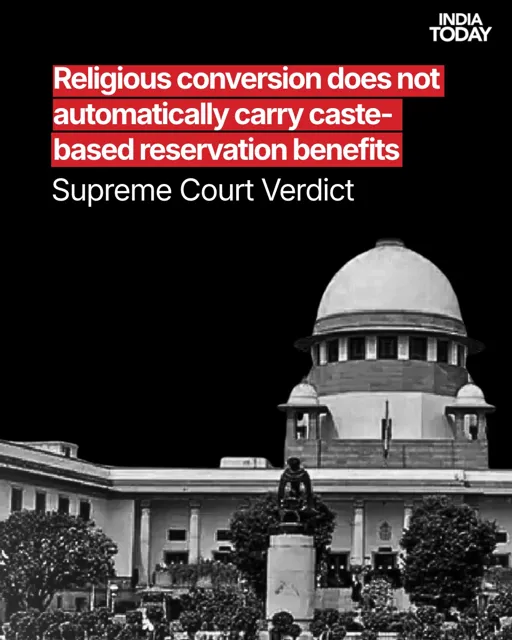
| Case Summary | The Supreme Court upheld the Madras High Court's 2024 verdict that individuals converting from Hinduism to Islam cannot claim backward class reservation based on their pre-conversion caste identity. |
| 2024 Tamil Nadu Order | In 2024, the Tamil Nadu government allowed converts to Islam to be classified as Backward Class (Muslim) and avail reservation benefits. This included individuals from Backward Classes (BC), Most Backward Classes (MBC), Denotified Communities (DNC), and Scheduled Castes (SC). The Madras High Court deemed this order unconstitutional. |
| Key Legal Provision | Article 16(4) of the Indian Constitution allows reservation in public employment for backward classes not adequately represented in state services. The judgment clarified that reservation eligibility post-conversion depends on constitutional and legal criteria. |
| Reconversion Ruling | The Supreme Court ruled that reconversion to Hinduism does not automatically restore reservation rights. A case-by-case determination is required to assess revival of caste identity and fulfillment of legal criteria. |
| Significance | 1. Reservation: Pre-conversion caste status does not guarantee reservation post-conversion. 2. State Powers: Government orders on reservations must comply with constitutional provisions. 3. Caste Identity: Reconversion claims must be evaluated based on relevant facts and laws. |
Supreme Court Rules Against Backward Class Reservation Post Religious Conversion
16 October, 2026
1 min read
•Daily Current Affairs
Englishहिंदी
ToppersNotes AppFree Download
Download App for More Daily Current Affairs & Quizzes
Get daily bulletins, quick exam notes, practice quizzes & instant updates on your phone.
Google Play500K+ Aspirants
 Scan to Download
ToppersNotes App