| Aspect | Details |
|---|---|
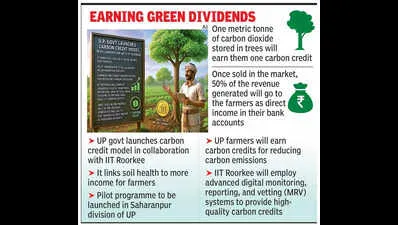
| Event | Uttar Pradesh government launches carbon credit model with IIT Roorkee. |
| Objective | Help farmers earn extra income by retaining carbon in agricultural fields and reducing greenhouse gas emissions. |
| First in India | First large-scale carbon credit model in India, starting in Saharanpur division, expanding statewide. |
| Carbon Credits | Farmers earn credits by planting trees absorbing CO₂. 1 metric tonne = 1 carbon credit, monetized for payments. |
| Revenue Sharing | 50% of revenue from carbon credit sales directly paid to farmers. |
| Sustainable Practices | Farmers must adopt practices like using agricultural waste, minimizing tillage, switching to biofertilizers. |
| Income and Soil Health | Offers long-term income, restores soil health, improves water retention, reduces farm costs. |
| Scientific Monitoring | IIT Roorkee verifies carbon content via lab tests, uses remote sensing for monitoring. |
| Revenue Allocation | 50% to farmers, 50% for land registration, maintenance, monitoring, and operations. |
| Global and Local Impact | Supports Net Zero commitments, facilitates global carbon credit sales, benefits rural livelihoods. |
| Long-Term Benefits | Improves soil fertility, water retention, crop yields, aids India's climate goals. |
| Carbon Credits Concept | Introduced by Kyoto Protocol, 1997, reinforced by Paris Agreement, 2015, aimed at GHG reduction. |
| Certification | Credits certified by bodies like Verified Carbon Standard (VCS) and Gold Standard. |

Contact Counsellor