Is the RTI Act fulfilling its purpose?
- The Right to Information (RTI) Act was passed by Parliament in 2005, aiming to give people access to the records of the Central and State governments.
- It was a vital reform to help activists and individuals ensure transparency and accountability in governance.
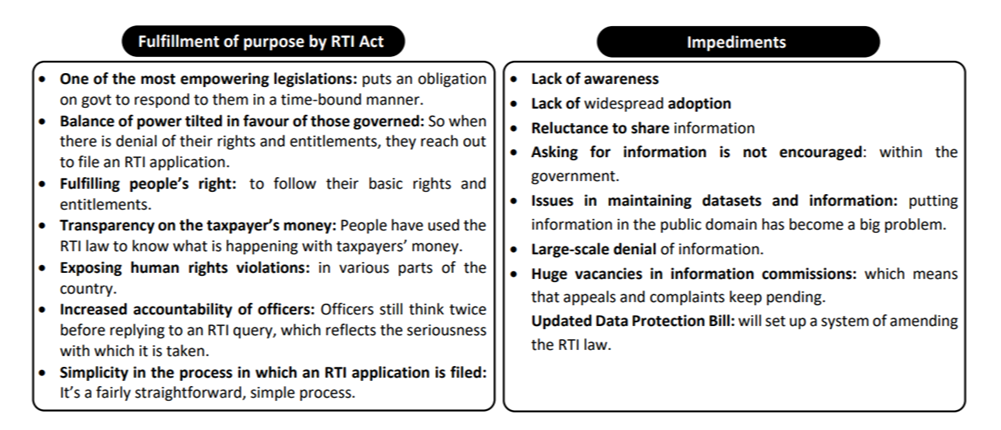
Fulfillment of purpose by RTI Act
- One of the most empowering legislations: puts an obligation on govt to respond to them in a time-bound manner.
- Balance of power tilted in favour of those governed: So when there is denial of their rights and entitlements, they reach out to file an RTI application.
- Fulfilling people’s right: to follow their basic rights and entitlements.
- Transparency on the taxpayer’s money: People have used the RTI law to know what is happening with taxpayers’ money.
- Exposing human rights violations: in various parts of the country.
- Increased accountability of officers: Officers still think twice before replying to an RTI query, which reflects the seriousness with which it is taken.
- Simplicity in the process in which an RTI application is filed: It’s a fairly straightforward, simple process.
Impediments
- Lack of awareness
- Lack of widespread adoption
- Reluctance to share information
- Asking for information is not encouraged: within the government.
- Issues in maintaining datasets and information: putting information in the public domain has become a big problem.
- Large-scale denial of information.
- Huge vacancies in information commissions: which means that appeals and complaints keep pending.
- Updated Data Protection Bill: will set up a system of amending the RTI law.